
Making a product is easy. Well, it’s easy when you compare it to setting your prices.
Here is one straightforward way to figure prices for what you produce:
- Materials + labor + fixed costs per unit + capital costs + profit = Wholesale
- Wholesale x 2 = Retail
Then, treat that as a starting point, and adjust for strategy and competitiveness.
Let’s talk through each factor in the formula.
Materials
You know to count all the direct and obvious materials. Don’t overlook the little things: thread, a shot of WD-40, seasonings. Whatever it is in your case.
Labor
Make sure you’re including all the time it takes, including setup and finishing. What about time for packaging and preparing for shipping?
There are at least two different ways to put a price on the labor. The first is, what would it cost you to hire someone to do this for you?
The second is, what is your time worth? If you tend to put a low price on your time, think about what your reaction would be if someone tried to hire you to do this.
Fixed costs
Fixed costs are all the costs you have to pay whether you produce anything or not. Utilities, rent, interest payments, everything else. Pay attention to every single bill you pay and all your recurring payments that you may not normally notice. Total them all up for a single month. To allocate these costs to each item you make, you need to know how many items you can make, or you actually do make, in a given month. If you only produce one sculpture per month, it has to cover all the fixed costs. If you make 1,000 bars of soap per month, divide the total fixed costs by 1,000. That’s your fixed costs per unit for the formula.
Capital costs
Next, consider your equipment. How long will your equipment last? Can you make a guess of when you’ll need to replace it, and how much that might cost? Remember to save for upgraded equipment in the future. Make your best estimate of equipment cost per unit, and add that to your formula.
Profit
You deserve to make one, and if you don’t plan for it, you won’t get one. How much should you add per unit? One common place to start is to make profit equal to material costs.
Time to Adjust
OK. You added all the factors up. Like this:
- Materials + labor + fixed costs per unit + capital costs + profit
Each of these factors is too important to leave out, so this is the lowest price you should sell for. Since this is lowest price you can sell for, it is the wholesale price.
Most retailers will likely take your wholesale price and double it. That’s the most common retail pricing strategy, keystone pricing. Since you know that, you can set your retail price at twice your wholesale price.
- Wholesale x 2 = Retail
Now that you’ve done all that math, you know what your costs and pricing would be. Before you rush to the market, you’d like to know what other businesses’ costs and pricing are. Then you can decide how you compare, and what strategy you want to factor in.
Do some price checking on the other comparable products. How are they priced? Before you say there is nothing out there like yours, at least figure out something similar to compare to.
Next consider what tier of pricing you want to fit into: top of market to bottom of market. And before you go for the bottom of the market, I’ll remind you that you can’t win the race to the bottom.
It’s not easy
Given all the work you put into figuring out your products and actually making them, you deserve to get the pricing right.
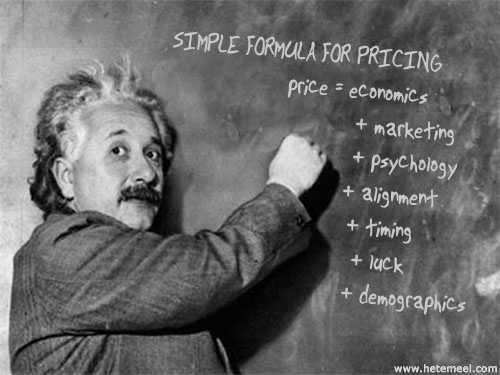
By the way, the complicated pricing formula on the chalkboard with Einstein:
- Pricing=economics+marketing+psychology+alignment+timing+luck+demographics
I heard it at the 2009 Oklahoma Entrepreneurship Conference from Dr. Glenn Freedman, who was then with the Oklahoma State University Center for Innovation and Economic Development.
New to SmallBizSurvival.com? Take the Guided Tour. Like what you see? Get our updates.
- About the Author
- Latest by this Author

Becky started Small Biz Survival in 2006 to share rural business and community building stories and ideas with other small town business people. She and her husband have a small cattle ranch and are lifelong entrepreneurs. Becky is an international speaker on small business and rural topics.




My friend Eric Brown commented via LinkedIn:
“Ah, pricing our product offerings and wares, perhaps the most difficult piece to business, as we have a tendency to way underprice.”
Pricing your handmade product IS the hardest thing! Your formula is a good one! I took a business class and she kept talking about selling Wholesale which is something I just couldn’t bring myself to do because there is no profit in that as opposed to Retail (and as a one woman production that didn’t mass produce anything, it just wasn’t feasible). You put the same amount of time into a piece regardless of how it sells. In my boutique in CA, I priced for the area, similar goods and what people were willing to pay. I had other Boutique owners buy from me, paying full retail, to re-sell in their upscale Boutiques in bigger cities. Husband and I had many debates about raising prices because of that BUT my products MOVED and my repeat customers shopped more frequently because they knew my merchandise moved. I feel I was the winner. I wasn’t discounting my product for someone else’s benefit and my bills were being paid and I had money left over. My logic might not work for everyone or may even cause a few eyes to roll but it worked for me and I created a solid customer base. I haven’t reopened my business yet since our move to AL but I will in the near future. Still weighing the pro’s and con’s of a brick and mortar, which our little town desperately needs (but I worry about making it) or starting with e-commerce and having a traveling Boutique (shows) like I did when I first opened my business. I’m having my husband build me a studio in our backyard because I have been asked by several people to teach a class on painting techniques. I’m pretty sure that’ll be my starting place. :)
Amber, you’ve tested your approach and it worked for you. That’s a good approach, then, in my book. I do like to see people build their profit in even at the wholesale price. That’s only fair to yourself.
On the getting started question, starting with classes is a great place to start. Don’t jump into your own store too soon. Look for ways to start your retailing in stages or steps. You mention traveling to shows, and you can also try a pop-up or temporary store, partnering with another artisan or crafter to share space, or working with another business that maybe is completely unrelated. Maybe the local real estate office has more space than they need for a lobby, perfect for your display!
Great ideas, Becky! We have our town fair coming up in a couple of months that closes off main street to traffic. Might be a good time to get a feel for my market!